Why Does Your AC Keep Turning On and Off?
You are trying to relax, and your air conditioner will not settle down. It kicks on, runs for a minute or two, clicks off, then starts the whole thing over again a few minutes later. The house never quite gets comfortable, and that constant clicking on and off has a name in the trade: short cycling. It is worth understanding what causes short cycling before it turns into a bigger repair.
During a Florida summer, short cycling is one of the most common complaints we hear. The good news is that a couple of the causes are things you can check yourself in five minutes. The rest point to something inside the system that needs a professional, and knowing the difference can save you money and a very uncomfortable afternoon.
What Short Cycling Actually Is
A healthy air conditioner runs in long, steady cycles. It comes on, runs until the house reaches the temperature you set, and shuts off for a good while before it needs to run again. Short cycling is when that rhythm breaks down and the system runs in short, frequent bursts instead, switching on and off far more often than it should without ever completing a full cooling cycle.
The reason this matters goes beyond the annoyance of the noise. Starting up is the hardest thing an air conditioner does, drawing the most power and putting the most strain on the motor and compressor. A system that starts and stops all day is wearing out the exact parts that are most expensive to replace, all while using more electricity and leaving your home humid and unevenly cooled. Left alone, a nuisance today becomes a failed compressor down the road.
Start With the Air Filter
Before you assume the worst, check the simplest thing. A clogged air filter is one of the leading causes of short cycling, and it is the one problem you can fix yourself in a couple of minutes. When the filter is packed with dust and pet hair, it chokes off the airflow the system needs to run properly. The unit overheats, trips its own safety limit, shuts down to protect itself, and then starts the cycle again once it cools.
Pull the filter out and hold it up to the light. If you cannot see through it, replace it. In our climate, with the system running nearly year round and doors opening onto dust and pollen, filters clog faster than most homeowners expect, so checking it every month during cooling season is a good habit. If a fresh filter fixes the cycling, you have solved it for the price of a filter. If the problem continues, it is time to look at the thermostat.
Check the Thermostat and Its Placement
Your thermostat is the brain of the system, and when it misreads the room it tells the air conditioner to start and stop at the wrong times. Sometimes the fix is as simple as fresh batteries or a setting that got bumped, both of which you can handle yourself. Confirm it is set to cool, that the temperature is where you want it, and that the fan is set to auto rather than on.
Placement is the sneakier culprit. A thermostat mounted in direct sunlight, above a supply vent, or on a wall that runs warm will sense a false temperature spike, satisfy quickly, and shut the system off before the rest of the house is actually cool. Then the real room temperature catches up and it fires again. If the thermostat is in a bad spot or simply failing with age, that is worth a professional look, since the right sensor in the right place is the difference between steady comfort and a system that never rests. Upgrading to a modern smart thermostat often clears up cycling caused by an old or poorly placed unit.
Short Cycling Causes That Need a Professional
If the filter and thermostat check out, the remaining causes live deeper in the system and are not do-it-yourself territory. Low refrigerant, usually from a leak, is a frequent one. As the charge drops, pressures fall and the system trips off and on trying to protect itself, and simply adding refrigerant without finding the leak only buys a little time. Refrigerant is not something a homeowner should handle, so this is a clear call for AC repair.
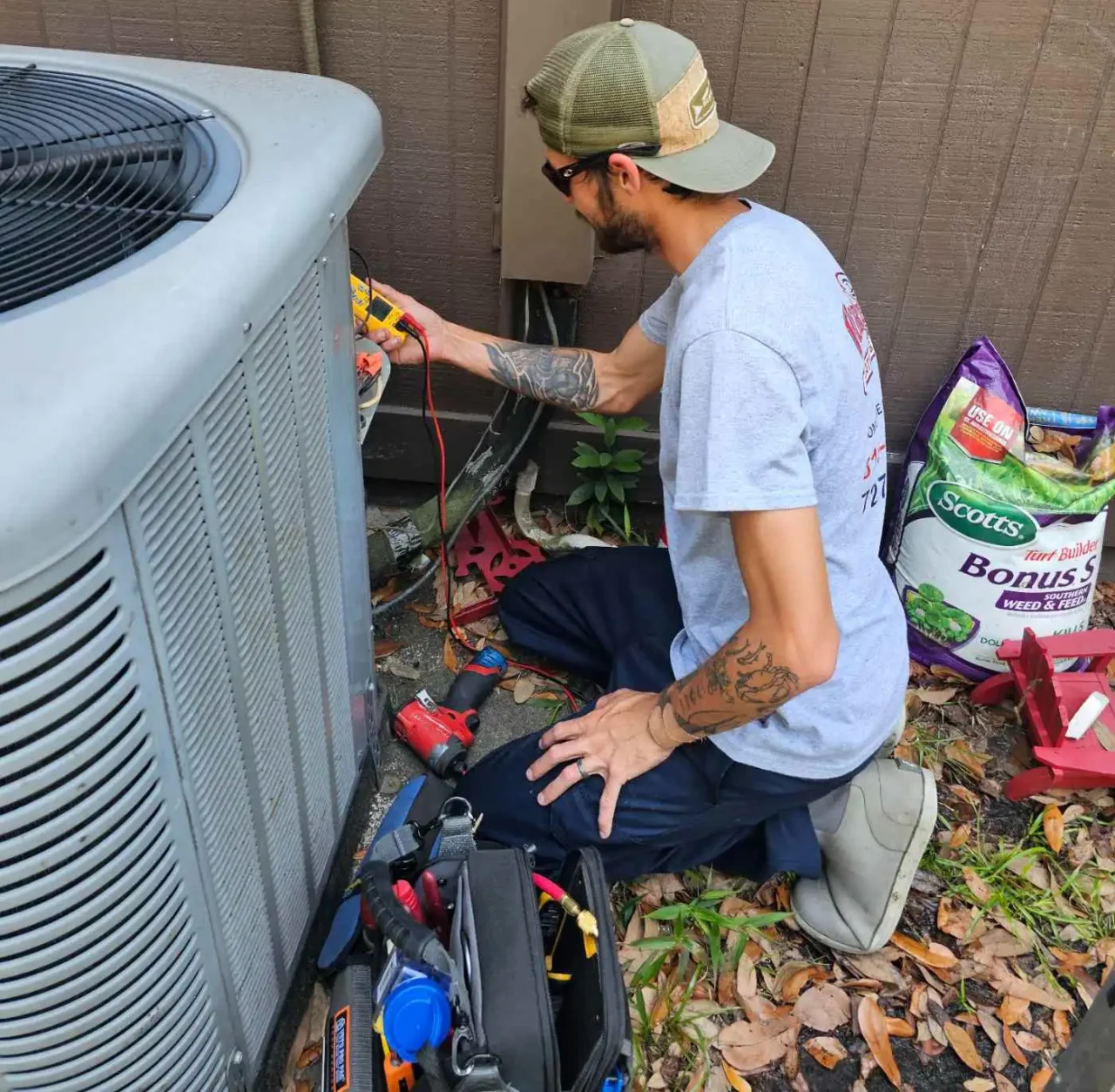
A frozen evaporator coil produces the same stop-and-start behavior. When airflow is restricted or the charge is low, the coil ices over, the system shuts down, and it kicks back on once it thaws just enough to run again, which is one reason a dirty coil that needs AC coil cleaning can quietly trigger cycling. Electrical faults round out the list, and a failing capacitor is a common one, since that component gives the motor the jolt it needs to start. When it weakens, the system struggles to start, shuts down, and tries again in a hard cycle that quickly wears everything out. All of these need someone who can measure pressures, test components, and find the actual root cause.
Why an Oversized System Keeps Short Cycling
Sometimes the equipment itself is the problem, and no repair will fully cure it. An air conditioner that is too powerful for the home cools the space so quickly that it satisfies the thermostat and shuts off within a few minutes, well before it has run long enough to pull the humidity out of the air. A short while later the temperature drifts up and it fires again, repeating that pattern all day.
This is one reason correct sizing matters so much on a new install, and why an oversized unit short cycles no matter how well it is maintained. If your system has always cycled quickly since the day it went in, the issue may be the size rather than a broken part, and the long-term answer is properly sized equipment. Either way, catching cycling early and keeping the system tuned with a maintenance plan is what keeps a small pattern from becoming a large repair bill.
Don’t Wait for the System to Quit
Short cycling is your air conditioner telling you something is wrong, and the longer it goes on, the more wear it puts on the parts you least want to replace. Check the filter and the thermostat first, since those are the easy wins. If the cycling keeps up after that, do not wait for a July breakdown to make the call. Reach Vortex Heating & Cooling at 813-427-9100 and we will find out why your system will not settle down and get your home cooling the way it should.